
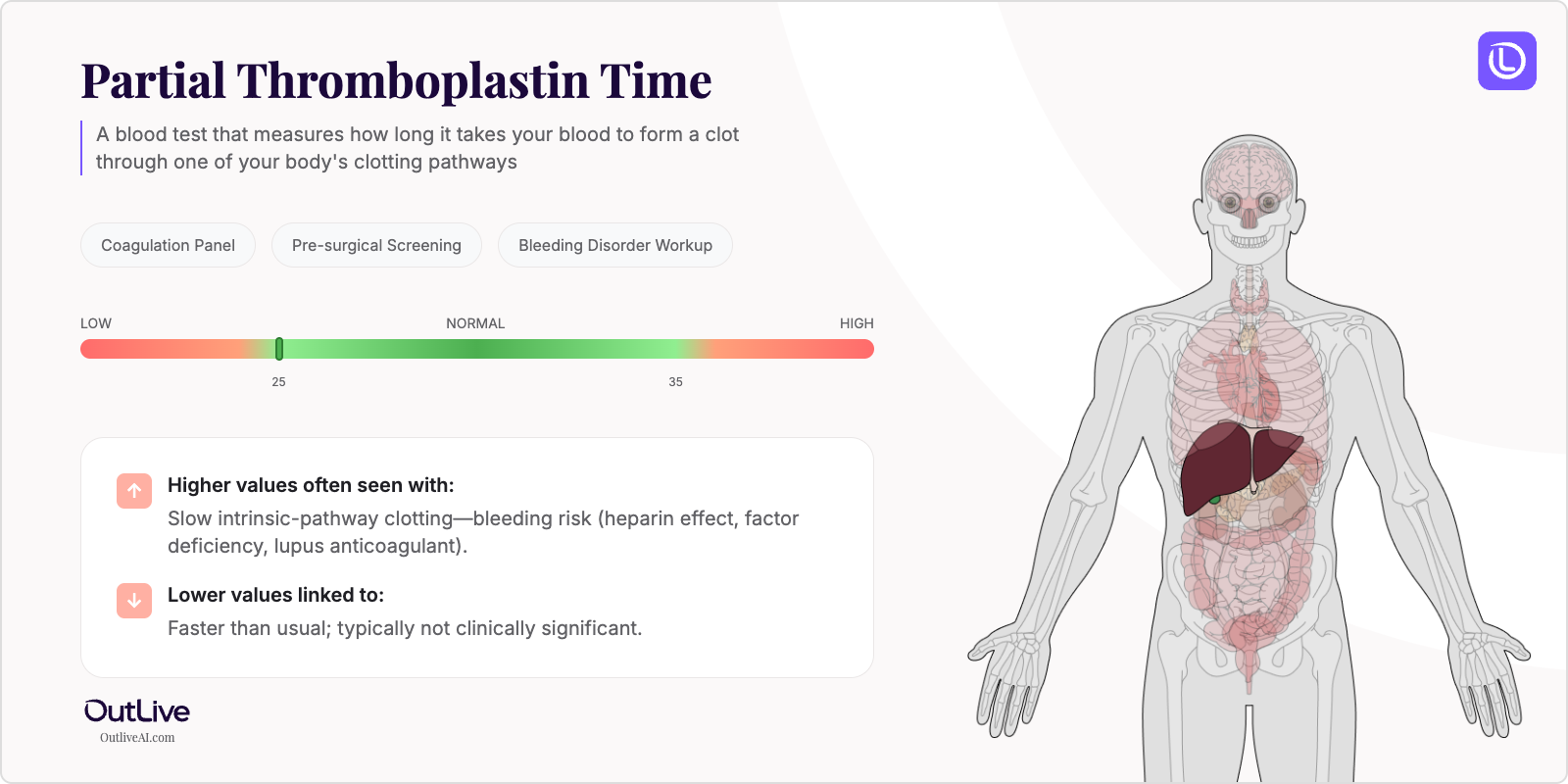
📋 At a Glance
- What it is: A blood test that measures how long it takes your blood to form a clot through one of your body's clotting pathways
- Found in tests: Coagulation Panel, Pre-surgical Screening, Bleeding Disorder Workup
- Normal range: 25-35 seconds (may vary slightly by laboratory)
If you're looking at your lab results and wondering what PTT means, you're in the right place. Think of PTT as a stopwatch that measures how quickly your blood's "emergency repair team" springs into action when you have a cut or injury. Just like a well-trained emergency response team needs the right amount of time to do their job properly – not too fast, not too slow – your blood needs to clot at just the right speed to keep you healthy. Let's break down what your numbers mean in plain English.
Why Is PTT (Partial Thromboplastin Time) Tested?
Your doctor orders a PTT test when they need to understand how well your blood clots. It's like checking if your body's internal bandaging system is working properly. This test is particularly important before surgeries, when investigating unexplained bleeding or bruising, or when monitoring certain blood-thinning medications.
PTT is commonly included in pre-operative screening panels to ensure you won't have excessive bleeding during surgery. It's also a key test when doctors suspect bleeding disorders like hemophilia or von Willebrand disease. If you're taking heparin (a blood thinner), your medical team uses PTT to make sure your dose is just right – enough to prevent dangerous clots but not so much that you bleed too easily.
This test matters because your clotting ability affects everything from how quickly a paper cut stops bleeding to how your body responds during surgery or after an injury. Understanding your PTT helps your healthcare team keep you safe during medical procedures and manage any clotting conditions you might have.
What Does PTT (Partial Thromboplastin Time) Do in Your Body?
PTT doesn't actually "do" anything in your body – it's a measurement of how your clotting cascade works. Think of your clotting system like a line of dominoes. When you get injured, the first domino falls (activation), triggering a chain reaction of clotting factors (proteins in your blood) that ultimately forms a protective mesh to stop bleeding. PTT specifically measures the "intrinsic pathway" – one of two main routes your body uses to form clots.
Your liver produces most of the clotting factors measured by PTT, and they circulate in your bloodstream like firefighters waiting for an alarm. When bleeding occurs, these factors activate in a specific sequence, each one activating the next, until fibrin (the protein that forms the actual clot) is produced. This process involves factors XII, XI, IX, and VIII, among others – think of them as specialized team members, each with a crucial role.
PTT works alongside other clotting tests like PT (Prothrombin Time) to give your doctor a complete picture of your clotting ability. While PT measures the "extrinsic pathway" (the other main clotting route), PTT focuses on the intrinsic pathway. Together, they're like checking both the front and back doors of your house to make sure everything is secure.
What Do My Partial Thromboplastin Time Results Mean?
Normal Partial Thromboplastin Time Ranges
| Population | Normal Range | Optimal Range |
|---|---|---|
| Adult Male | 25-35 seconds | 28-32 seconds |
| Adult Female | 25-35 seconds | 28-32 seconds |
| Children | 24-36 seconds | 28-32 seconds |
| Pregnancy | 24-34 seconds | 26-31 seconds |
Note: Reference ranges may vary slightly between laboratories. Always compare your results to the range provided on your specific lab report.
What Does High Partial Thromboplastin Time Mean?
When your PTT is high (prolonged), it means your blood is taking longer than normal to clot. Think of it like a sluggish emergency response team – they'll eventually get the job done, but it takes longer than it should.
Common Causes:
- Heparin therapy: The most common cause – if you're on this blood thinner, a higher PTT is expected and monitored
- Hemophilia A or B: Inherited conditions where you're missing specific clotting factors (VIII or IX)
- Von Willebrand disease: The most common inherited bleeding disorder, affecting how platelets stick together
- Liver disease: Your liver makes clotting factors, so liver problems can slow clot formation
- Vitamin K deficiency: Essential for producing several clotting factors
- Lupus anticoagulant: Despite its name, this can actually cause clotting problems in some people
- Factor deficiencies: Missing or low levels of factors VIII, IX, XI, or XII
Possible Symptoms:
- Easy bruising from minor bumps
- Prolonged bleeding from cuts or dental work
- Heavy menstrual periods
- Nosebleeds that are hard to stop
- Blood in urine or stool
- Joint pain or swelling (from internal bleeding)
When to Be Concerned: Seek immediate medical attention if you have a high PTT along with severe headache (possible brain bleed), difficulty breathing, severe abdominal pain, or uncontrolled bleeding. A PTT over 70 seconds when you're not on blood thinners warrants urgent evaluation.
What Does Low Partial Thromboplastin Time Mean?
A low (shortened) PTT is less common and generally less concerning than a high PTT. It means your blood is clotting faster than usual – like an overeager repair crew that shows up before you've even finished assessing the damage.
Common Causes:
- Early DIC (Disseminated Intravascular Coagulation): A serious condition where clotting happens throughout the body
- Extensive cancer: Some cancers can trigger increased clotting activity
- Acute phase reaction: Your body's response to inflammation or infection
- High factor VIII levels: Can occur with stress, exercise, or pregnancy
- Sample collection issues: Most commonly, contamination with tissue factor during blood draw
- Estrogen therapy or birth control pills: Can increase certain clotting factors
- Pregnancy: Natural increase in clotting factors to prevent bleeding during delivery
Possible Symptoms:
- Often no symptoms at all
- Leg swelling or pain (if blood clots form)
- Shortness of breath (if clots travel to lungs)
- Chest pain
When to Be Concerned: While a slightly shortened PTT is usually not dangerous, consistently low values combined with symptoms like leg swelling, chest pain, or shortness of breath require immediate evaluation as these could indicate dangerous blood clots.
What Can Affect My Partial Thromboplastin Time Levels?
Factors That May Increase Levels:
- Medications: Heparin, warfarin (at high doses), aspirin, antibiotics (some types), antihistamines
- Lifestyle: Heavy alcohol use, poor nutrition leading to vitamin deficiencies
- Conditions: Recent surgery, active bleeding, autoimmune disorders, recent blood transfusions
- Supplements: Fish oil, vitamin E, garlic supplements, ginkgo biloba
Factors That May Decrease Levels:
- Medications: Estrogen-containing birth control, hormone replacement therapy
- Lifestyle: Smoking, dehydration, prolonged sitting or immobility
- Conditions: Pregnancy, acute inflammation, stress, recent exercise
- Time of Day: PTT can be slightly shorter in the morning
How Is PTT (Partial Thromboplastin Time) Related to Other Tests?
PTT is rarely evaluated alone – it's part of your body's clotting story that needs multiple chapters to understand fully.
Often tested alongside: PT/INR (Prothrombin Time), Platelet count, Fibrinogen, D-dimer Part of: Coagulation Panel, Pre-surgical screening Ratio calculations: aPTT ratio (your result divided by normal control) Follow-up tests: Specific factor assays (VIII, IX, XI, XII), Mixing studies, Lupus anticoagulant panel
Frequently Asked Questions
How often should Partial Thromboplastin Time be tested? For most people, PTT is only tested before surgery or when investigating bleeding problems. If you're on heparin therapy, it may be checked every 6 hours initially, then daily once stable. Those with bleeding disorders might need testing every 3-6 months or before any procedures.
Can I improve my Partial Thromboplastin Time levels naturally? If your PTT is abnormal due to nutritional deficiencies, eating vitamin K-rich foods (leafy greens, broccoli) and maintaining good liver health through limited alcohol and a balanced diet can help. However, most PTT abnormalities require medical management, not just lifestyle changes.
Should I fast before a Partial Thromboplastin Time test? No fasting is required for a PTT test. You can eat and drink normally before the test.
How quickly can Partial Thromboplastin Time levels change? PTT can change within hours when starting or stopping heparin. Factor deficiencies develop over days to weeks, while acute conditions like DIC can alter PTT within hours. Nutritional improvements take weeks to months to affect PTT.
Next Steps After Your Partial Thromboplastin Time Test
Questions to Ask Your Doctor:
- What do my Partial Thromboplastin Time results mean for my overall health?
- Are my levels related to my symptoms?
- Do I need additional testing?
- Should we monitor this over time?
- Are there lifestyle changes that could help?
- Do I need to take any precautions before dental work or surgery?
- Should my family members be tested for bleeding disorders?
Download our PTT (Partial Thromboplastin Time) Doctor Questions Checklist
🔬 Ready to Track Your PTT (Partial Thromboplastin Time) Over Time?
Understanding a single Partial Thromboplastin Time result is just the beginning. Our free Lab Analyzer tool helps you:
- Track how your PTT changes over time
- See how it relates to your other lab values
- Identify patterns your doctor might miss
- Get personalized insights based on your trends
[Upload Your Lab Report for Free Analysis →]