
📋 At a Glance
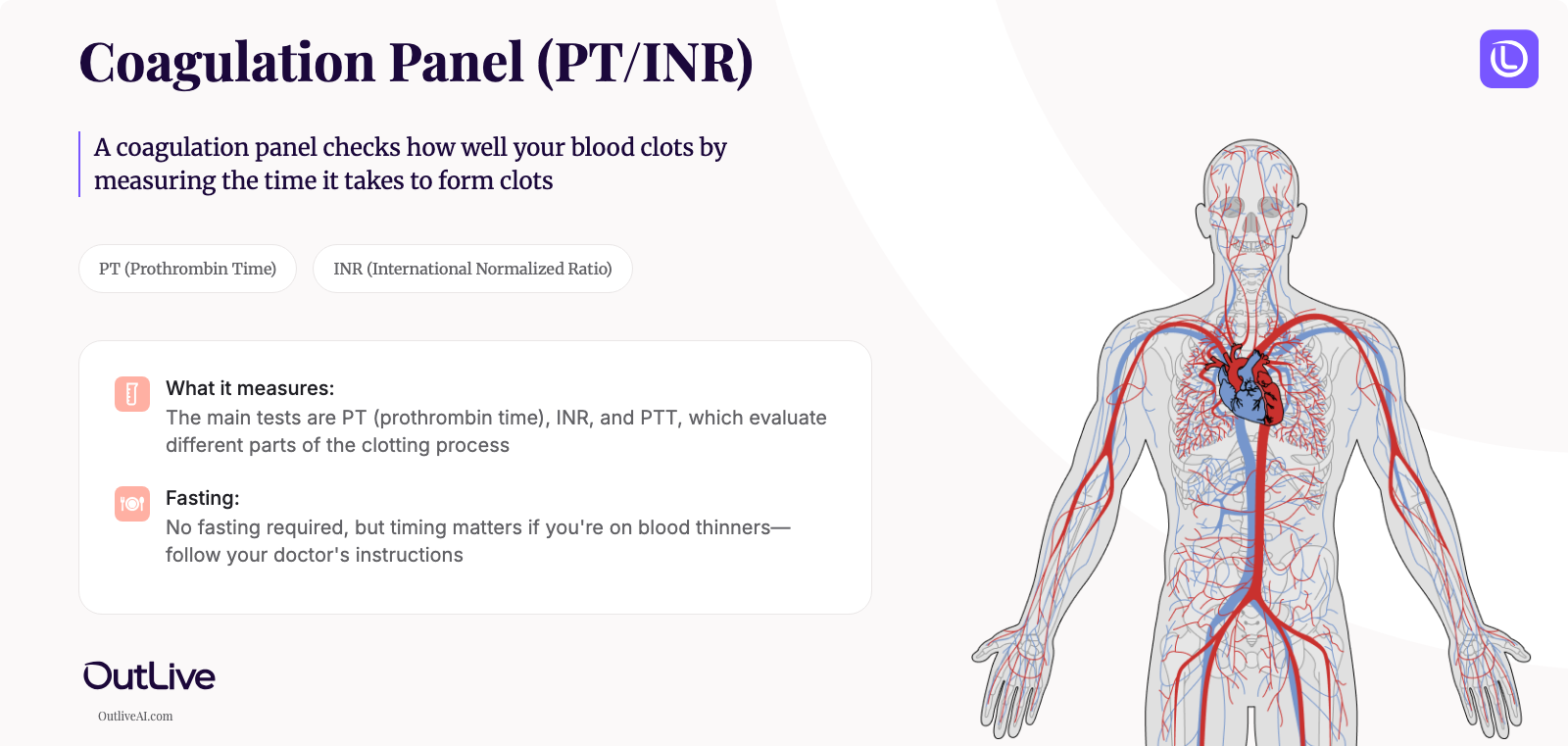
- A coagulation panel checks how well your blood clots by measuring the time it takes to form clots
- The main tests are PT (prothrombin time), INR, and PTT, which evaluate different parts of the clotting process
- No fasting required, but timing matters if you're on blood thinners—follow your doctor's instructions
If you're reading this, you've likely just had a Coagulation Panel and are looking at results with terms like "PT," "INR," and "PTT" that might seem confusing. Take a breath. You're in the right place. This guide will walk you through what a coagulation panel is, what each of those measurements means for your clotting ability, and most importantly, what you should do next. Think of us as your translator—we're here to help you understand your results so you can have a more informed conversation with your healthcare provider.
Why Is a Coagulation Panel Ordered?
Your doctor might order a coagulation panel for several reasons. Think of your clotting system as your body's emergency repair crew—when you get a cut, this system springs into action to stop the bleeding. But it needs to work just right: too little clotting leads to excessive bleeding, while too much can cause dangerous blood clots.
The most common reasons include:
Pre-surgery screening: Before any surgery or invasive procedure, doctors need to ensure your blood will clot properly to prevent excessive bleeding during and after the procedure.
Monitoring blood thinners: If you take warfarin (Coumadin), regular PT/INR tests ensure your dose keeps you in the safe therapeutic range—preventing clots without causing bleeding.
Investigating bleeding problems: If you have unexplained bruising, frequent nosebleeds, heavy menstrual periods, or prolonged bleeding after injury, these tests help identify clotting disorders.
Liver disease evaluation: Your liver makes most clotting factors. A coagulation panel helps assess liver function and bleeding risk in liver disease.
Evaluating unexplained clots: If you've had a blood clot (DVT, PE, stroke) without obvious cause, testing helps identify clotting disorders that increase clot risk.
Family history of bleeding disorders: If relatives have hemophilia or other bleeding disorders, testing can determine if you're affected or a carrier.
Medication effects: Certain antibiotics, heart medications, and other drugs can affect clotting. Testing ensures these medications aren't causing problems.
Vitamin K deficiency: Since vitamin K is essential for clotting, deficiency from malnutrition, malabsorption, or certain medications requires monitoring.
Remember, your clotting system involves over a dozen different factors working in a precise cascade—these tests help ensure each step is working properly.
How to Prepare for a Coagulation Panel Test
Preparing for a coagulation panel is relatively simple, but timing can be important:
No fasting required: You can eat and drink normally before the test. Food doesn't significantly affect coagulation results.
Medication timing for warfarin users:
- Test at the same time of day for consistency
- Take your warfarin dose as prescribed
- Most doctors prefer testing before your daily dose
- Keep a consistent diet (especially vitamin K foods) before testing
Inform your doctor about:
- All medications (prescription and over-the-counter)
- Supplements, especially vitamin K, E, fish oil, garlic
- Herbal remedies (many affect clotting)
- Recent illnesses or infections
- Any recent changes in diet or alcohol intake
Special considerations:
- Avoid aspirin and NSAIDs for several days before if possible (check with doctor first)
- Don't change your routine before testing—results should reflect your normal state
- If bruising easily, inform the phlebotomist for extra pressure after the draw
Sample collection: The blood must be collected in a special blue-top tube with precise filling. If underfilled, results may be inaccurate. The sample is processed quickly as clotting factors can degrade.
Understanding the Components of Your Coagulation Panel Report
Your coagulation panel evaluates different pathways your body uses to form blood clots. Think of it like testing different parts of an assembly line—each test checks if specific steps are working properly.
What Do the Basic Coagulation Tests Mean?
The main tests evaluate how quickly your blood clots through different pathways:
PT (Prothrombin Time): Measures how long it takes your blood to clot through the "extrinsic pathway"—the body's rapid response to injury. PT primarily tests factors made by your liver using vitamin K. Think of it as testing your body's emergency clotting response. Normal range is typically 11-13.5 seconds.
INR (International Normalized Ratio): A standardized way to report PT results, making them comparable between labs worldwide. INR is calculated from PT and is crucial for monitoring warfarin therapy. For people not on blood thinners, normal INR is 0.8-1.1. For those on warfarin, target ranges vary by condition (usually 2.0-3.0 or 2.5-3.5).
PTT/aPTT (Partial Thromboplastin Time): Measures clotting through the "intrinsic pathway"—a slower but important backup system. PTT tests different factors than PT and is used to monitor heparin therapy and detect certain clotting disorders like hemophilia. Normal range is typically 25-35 seconds.
Thrombin Time (TT): Measures the final step of clot formation—converting fibrinogen to fibrin. Abnormal TT can indicate fibrinogen problems, liver disease, or presence of heparin. Normal range is typically 14-19 seconds.
Fibrinogen: The protein that forms the actual clot structure. Low levels cause bleeding; high levels increase clot risk. Normal range is 200-400 mg/dL.
Here are the typical ranges for basic coagulation tests:
| Component | Abbreviation | Normal Range | Therapeutic Range (if applicable) |
|---|---|---|---|
| PT | PT | 11-13.5 seconds | N/A |
| INR (not on warfarin) | INR | 0.8-1.1 | N/A |
| INR (on warfarin) | INR | N/A | 2.0-3.0 (most conditions) <br/ >2.5-3.5 (mechanical heart valves) |
| PTT | PTT/aPTT | 25-35 seconds | 60-80 seconds (on heparin) |
| Thrombin Time | TT | 14-19 seconds | N/A |
| Fibrinogen | Fib | 200-400 mg/dL | N/A |
What Do Specialized Coagulation Tests Mean?
Additional tests may be ordered to investigate specific problems:
D-Dimer: Detects breakdown products of blood clots. Elevated D-dimer suggests recent clot formation and breakdown. Used to rule out DVT or pulmonary embolism. Normal is <500 ng/mL.
Factor Assays: Measure specific clotting factors (Factor VIII, IX, etc.). Used to diagnose hemophilia and other specific factor deficiencies.
Mixing Studies: When PT or PTT is prolonged, mixing patient blood with normal blood helps determine if the problem is a deficiency (corrects) or an inhibitor/antibody (doesn't correct).
Lupus Anticoagulant: Despite the name, this actually increases clot risk. Part of antiphospholipid syndrome evaluation.
Anti-Xa Activity: Monitors newer anticoagulants like Lovenox or Xarelto. More specific than PTT for these medications.
Platelet Function Tests: Evaluate how well platelets work, not just their number. Important for unexplained bleeding despite normal routine tests.
What Do Abnormal Results Mean? (A High-Level Guide)
Coagulation results must be interpreted in context—what's abnormal depends on whether you're on blood thinners and your clinical situation:
Prolonged PT/High INR Pattern:
- Not on warfarin: Suggests vitamin K deficiency, liver disease, or clotting factor deficiency
- On warfarin:
- INR 2.0-3.0: Usually therapeutic for most conditions
- INR >4.0: Increased bleeding risk
- INR >5.0: High bleeding risk, may need vitamin K
- Common causes: Warfarin, liver disease, vitamin K deficiency, factor VII deficiency
- Symptoms of over-anticoagulation: Easy bruising, prolonged bleeding, blood in urine/stool
Prolonged PTT Pattern:
- Suggests problems with intrinsic pathway factors
- Common causes: Hemophilia A or B, von Willebrand disease, heparin therapy, lupus anticoagulant
- If PT normal but PTT prolonged: Usually intrinsic pathway problem
- On heparin: Target PTT 60-80 seconds for therapeutic anticoagulation
Both PT and PTT Prolonged:
- Suggests common pathway problems or multiple factor deficiencies
- Common causes: Severe liver disease, DIC, vitamin K deficiency, warfarin overdose
- May indicate serious condition requiring urgent treatment
Shortened PT or PTT:
- Less common but may indicate hypercoagulable state
- Can occur with elevated clotting factors
- May increase clot risk
Warfarin Monitoring Patterns:
- INR too low (<2.0): Inadequate anticoagulation, clot risk
- INR therapeutic (2.0-3.0 or 2.5-3.5): Good control
- INR too high (>3.5-4.0): Bleeding risk increases
- Factors affecting INR: Diet (vitamin K), medications, illness, alcohol
Liver Disease Pattern:
- Prolonged PT (liver makes factors II, VII, IX, X)
- Low fibrinogen (made by liver)
- PTT may be normal early, prolonged in advanced disease
- Won't correct with vitamin K (unlike vitamin K deficiency)
DIC (Disseminated Intravascular Coagulation) Pattern:
- Prolonged PT and PTT
- Low fibrinogen
- Low platelets
- High D-dimer
- Medical emergency requiring immediate treatment
Important disclaimer: Coagulation interpretation is complex and depends heavily on clinical context. Bleeding and clotting disorders can be serious. Never adjust blood thinner doses yourself. Only your healthcare provider can safely interpret results and adjust treatment. Seek immediate care for signs of serious bleeding or clots.
Next Steps After Your Coagulation Panel Test
So you've read through your results—what now? Here's your action plan:
1. Schedule a follow-up with your doctor: Any abnormalities need discussion, especially if you're on blood thinners or facing surgery.
2. Prepare your questions: Not sure what to ask? We've created a helpful checklist of questions to bring to your appointment. [Download our Coagulation Panel Doctor Questions Checklist](# to make sure you cover everything important.
3. If you're on warfarin:
- Understand your target INR range
- Keep consistent vitamin K intake
- Never skip or double doses
- Get regular monitoring as directed
- Keep a record of your INR results
4. Know the warning signs:
Signs of bleeding (INR too high):
- Unusual bruising or bleeding
- Blood in urine or stool
- Severe headache
- Coughing up blood
- Heavy menstrual bleeding
Signs of clotting (INR too low):
- Leg pain or swelling
- Chest pain or shortness of breath
- Sudden weakness or numbness
- Severe headache
- Vision changes
5. Lifestyle considerations:
- Inform all healthcare providers about blood thinners
- Use electric razors and soft toothbrushes if bleeding risk
- Avoid contact sports if on anticoagulation
- Wear medical alert identification
- Be consistent with diet and alcohol
6. Understand drug interactions: Many medications affect clotting—always check before starting new medications or supplements.
🔬 Ready to Translate Your Full Report?
Understanding your coagulation panel is just the beginning. Our free Lab Analyzer tool helps you:
- Track all your lab results in one place
- Spot important trends over time
- Generate personalized questions for your doctor
- Get plain-English explanations of every test
[Upload Your Lab Report for Free Analysis →]
Join 50,000+ people taking control of their health journey
Remember, knowledge is power when it comes to your health. Understanding your coagulation panel helps you work with your healthcare team to maintain the delicate balance between preventing dangerous clots and avoiding excessive bleeding. Whether you're monitoring blood thinners or investigating a bleeding problem, proper management can keep you safe. You've already taken the first step by educating yourself—now use that knowledge to be an active partner in your care.