
📋 At a Glance
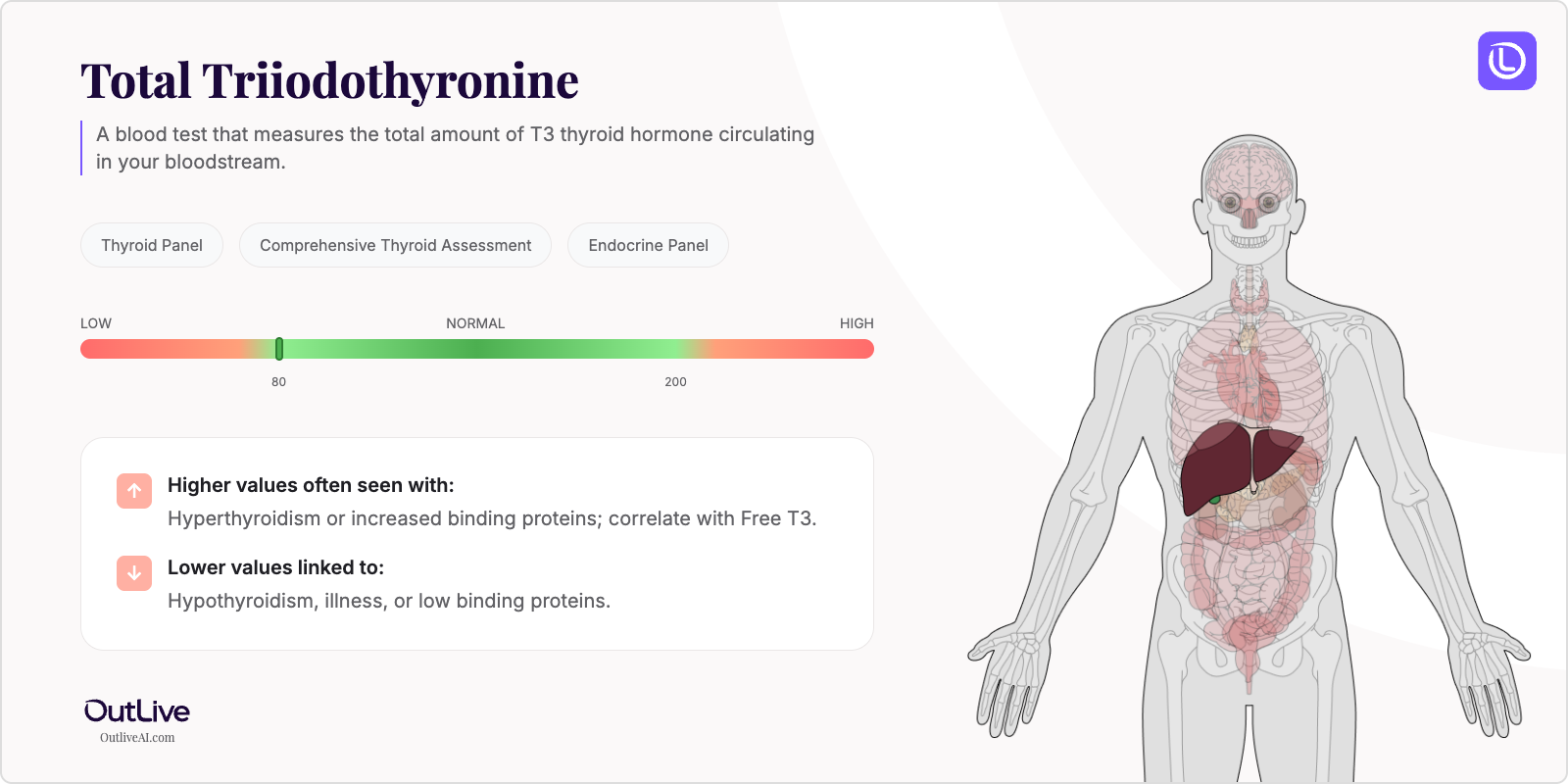
- What it is: A blood test that measures the total amount of T3 thyroid hormone circulating in your bloodstream.
- Found in tests: Thyroid Panel, Comprehensive Thyroid Assessment, Endocrine Panel
- Normal range: 80-200 ng/dL (may vary by lab and age)
If you're looking at your lab results and wondering what Total T3 means, you're in the right place. Think of Total T3 as your body's metabolic accelerator pedal – it's the active thyroid hormone that tells your cells how fast to work, from burning calories to keeping your heart beating at the right pace. Let's break down what your numbers mean in plain English.
Why Is Total T3 Tested?
Your doctor orders a Total T3 test when they want to get a complete picture of how your thyroid is functioning. This test is particularly helpful because T3 is the most active form of thyroid hormone – it's like the worker bee that actually gets things done in your cells, while T4 (another thyroid hormone) is more like the reserve supply waiting to be converted.
Total T3 testing becomes especially important when your doctor suspects hyperthyroidism (an overactive thyroid), as T3 levels often rise before other thyroid markers show changes. It's also ordered when your TSH or T4 levels are abnormal, when you have symptoms like unexplained weight changes, heart palpitations, or extreme fatigue, or when monitoring thyroid medication effectiveness.
This test is typically part of a comprehensive thyroid panel, which might include TSH, Free T4, and thyroid antibodies. Your doctor might also order it if you have a family history of thyroid disease or if you're experiencing symptoms that don't quite match your other thyroid test results.
What Does Total T3 Do in Your Body?
Total T3 is like your body's master controller for metabolism. Every cell in your body has receptors for T3, which means this hormone influences virtually every organ system. When T3 attaches to these receptors, it's like flipping a switch that tells your cells how much energy to produce and use.
Your thyroid gland produces about 20% of your T3 directly, while the remaining 80% comes from converting T4 (the storage form) into T3 in your liver, kidneys, and other tissues. This conversion process is why sometimes your T4 levels might look normal, but your T3 levels tell a different story – your body might be having trouble with that conversion process.
The "total" in Total T3 means we're measuring both the T3 that's bound to proteins (like a passenger on a bus) and the small amount that's freely floating in your blood (like someone walking on the sidewalk). Both forms matter because the bound T3 serves as a reserve that can become active when your body needs it.
What Do My Total T3 Results Mean?
Normal Total T3 Ranges
| Population | Normal Range | Optimal Range |
|---|---|---|
| Adult Male | 80-200 ng/dL | 100-180 ng/dL |
| Adult Female | 80-200 ng/dL | 100-180 ng/dL |
| Children (1-10 years) | 105-245 ng/dL | Not established |
| Adolescents (11-18 years) | 82-213 ng/dL | Not established |
| Pregnancy (2nd/3rd trimester) | 100-260 ng/dL | Varies by trimester |
| Elderly ( >65years) | 70-180 ng/dL | 80-160 ng/dL |
Note: Reference ranges may vary slightly between laboratories. Always compare your results to the range provided on your specific lab report.
What Does High Total T3 Mean?
Common Causes:
- Graves' disease: An autoimmune condition where your immune system overstimulates your thyroid
- Toxic multinodular goiter: Multiple overactive nodules in your thyroid gland
- Thyroid nodule (hot nodule): A single overactive area producing excess hormone
- Thyroiditis: Inflammation causing stored hormone to leak into your bloodstream
- Excessive thyroid medication: Taking too much levothyroxine or liothyronine
- T3 thyrotoxicosis: A rare condition where only T3 is elevated
- Pituitary adenoma: A benign tumor causing excess TSH production
Possible Symptoms:
- Rapid or irregular heartbeat
- Unexplained weight loss despite good appetite
- Anxiety, nervousness, or irritability
- Trembling hands
- Excessive sweating and heat intolerance
- Frequent bowel movements or diarrhea
- Difficulty sleeping
- Muscle weakness
- Thinning hair
When to Be Concerned: If your Total T3 is significantly elevated (above 250 ng/dL) and you're experiencing heart palpitations, chest pain, or extreme anxiety, contact your healthcare provider immediately. These could be signs of thyroid storm, a rare but serious condition requiring prompt treatment.
What Does Low Total T3 Mean?
Common Causes:
- Hypothyroidism: Underactive thyroid not producing enough hormone
- Hashimoto's thyroiditis: Autoimmune condition gradually destroying thyroid tissue
- Iodine deficiency: Lack of this essential mineral needed for hormone production
- Pituitary dysfunction: Problems with the gland that signals your thyroid
- Severe illness (euthyroid sick syndrome): Body conserves energy during major illness
- Certain medications: Including amiodarone, lithium, or high-dose steroids
- Post-thyroidectomy: After surgical removal of thyroid gland
Possible Symptoms:
- Fatigue and weakness
- Weight gain or difficulty losing weight
- Cold intolerance
- Dry skin and hair
- Constipation
- Depression or mood changes
- Muscle aches and stiffness
- Puffy face
- Slow heart rate
When to Be Concerned: Severely low T3 levels (below 50 ng/dL) combined with confusion, extreme fatigue, or very low body temperature warrant immediate medical attention, as these could indicate myxedema, a severe form of hypothyroidism.
What Can Affect My Total T3 Levels?
Factors That May Increase Levels:
- Medications: Birth control pills, estrogen therapy, methadone, clofibrate
- Lifestyle: High-iodine diet, excessive seaweed consumption, certain weight loss supplements
- Conditions: Pregnancy (especially first trimester), liver disease, acute psychiatric illness
- Supplements: Kelp supplements, iodine supplements, tyrosine supplements
Factors That May Decrease Levels:
- Medications: Propranolol, glucocorticoids, amiodarone, propylthiouracil (PTU)
- Lifestyle: Extreme calorie restriction, excessive exercise, chronic stress
- Conditions: Chronic kidney disease, liver cirrhosis, major surgery or trauma
- Time of Day: Levels can be slightly lower in the evening
How Is Total T3 Related to Other Tests?
Total T3 works like a team member with other thyroid tests to give your doctor the full picture. It's rarely interpreted alone – think of it as one instrument in an orchestra that needs to harmonize with the others.
Often tested alongside: TSH (Thyroid Stimulating Hormone), Free T4, Free T3, Reverse T3, Thyroid Antibodies (TPO, Thyroglobulin) Part of: Comprehensive Thyroid Panel, Endocrine Assessment Ratio calculations: T3/T4 ratio, T3/Reverse T3 ratio (used to assess conversion efficiency) Follow-up tests: If abnormal, your doctor might order thyroid ultrasound, radioactive iodine uptake test, or specific antibody tests
Frequently Asked Questions
How often should Total T3 be tested? If you're being treated for thyroid disease, your doctor typically checks levels every 6-12 weeks initially, then every 6-12 months once stable. For screening purposes in healthy adults, testing every 5 years is usually sufficient unless symptoms develop.
Can I improve my Total T3 levels naturally? Yes, several lifestyle factors can support healthy T3 levels: ensuring adequate iodine and selenium intake, managing stress, getting quality sleep, avoiding extreme dieting, and regular moderate exercise. However, true thyroid disease requires medical treatment.
Should I fast before a Total T3 test? Fasting isn't typically required for Total T3 testing, but eating can slightly affect levels. For consistency, many doctors prefer morning testing before breakfast. Always follow your specific lab's instructions.
How quickly can Total T3 levels change? T3 has a half-life of about 24 hours, meaning levels can change relatively quickly. After starting or adjusting thyroid medication, it typically takes 4-6 weeks for levels to stabilize at their new baseline.
Next Steps After Your Total T3 Test
Questions to Ask Your Doctor:
- What do my Total T3 results mean in the context of my other thyroid tests?
- Are my symptoms consistent with my T3 levels?
- Should we test for thyroid antibodies or do imaging studies?
- How often should I have my thyroid levels rechecked?
- Are there lifestyle changes that could help optimize my thyroid function?
- If medication is needed, which type would be best for my situation?
Download our Total T3 Doctor Questions Checklist
🔬 Ready to Track Your Total T3 Over Time?
Understanding a single Total T3 result is just the beginning. Our free Lab Analyzer tool helps you:
- Track how your Total T3 changes over time
- See how it relates to your other lab values
- Identify patterns your doctor might miss
- Get personalized insights based on your trends
[Upload Your Lab Report for Free Analysis →]