
📋 At a Glance
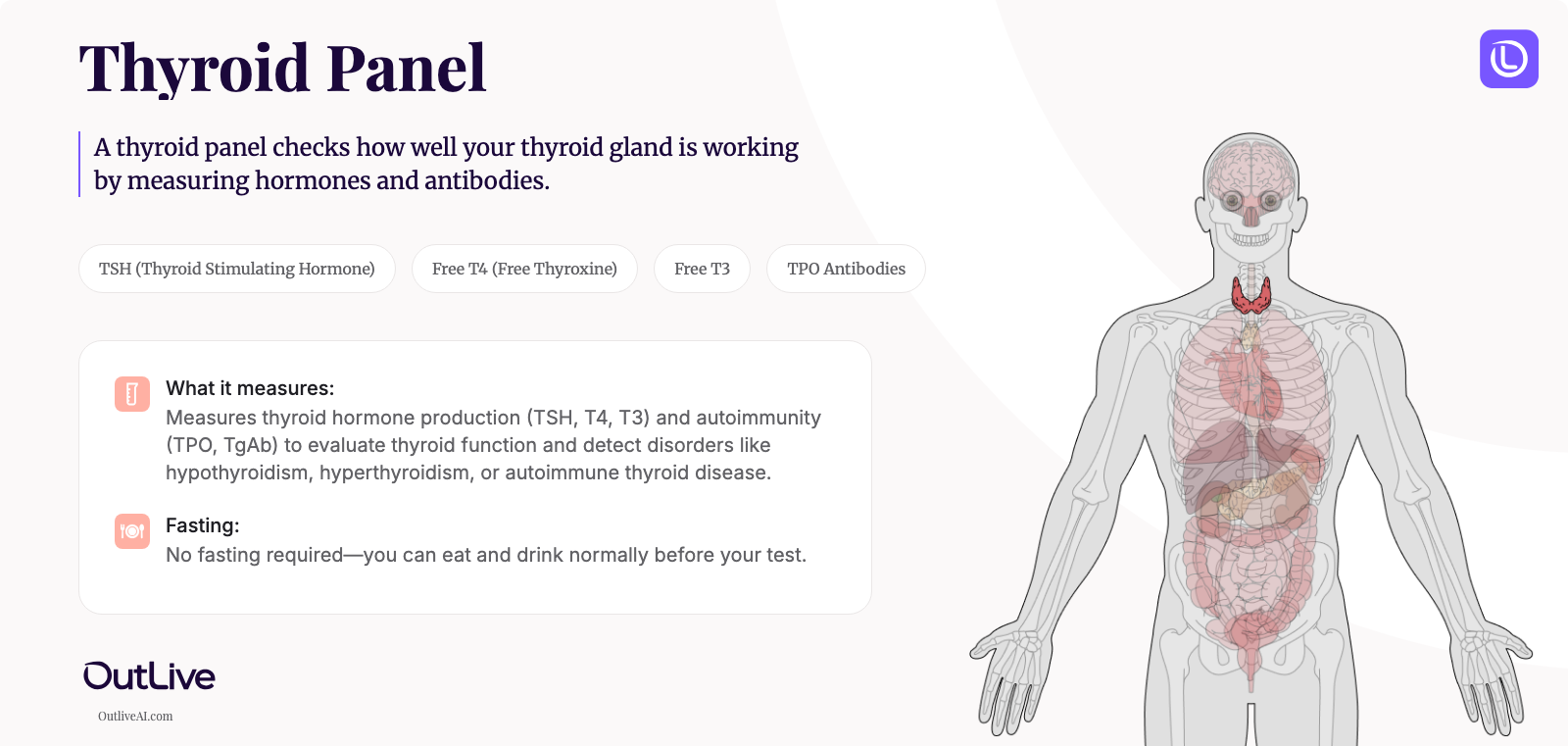
- A thyroid panel checks how well your thyroid gland is working by measuring hormones and antibodies
- The basic panel includes TSH and Free T4, while comprehensive panels add Free T3 and antibody tests
- No fasting required—you can eat and drink normally before your test
If you're reading this, you've likely just had a Thyroid Panel and are looking at results that might seem confusing—TSH, T4, T3, and possibly antibodies with long, complicated names. Take a breath. You're in the right place. This guide will walk you through what a thyroid panel is, what each of those measurements means for your health, and most importantly, what you should do next. Think of us as your translator—we're here to help you understand your results so you can have a more informed conversation with your healthcare provider.
Why Is a Thyroid Panel Ordered?
Your doctor might order a thyroid panel for several reasons. Think of your thyroid as your body's thermostat—it controls how fast or slow everything runs, from your heart rate to how quickly you burn calories. When it's not working properly, you feel it throughout your entire body.
The most common reasons include:
Investigating symptoms: If you're experiencing fatigue, weight changes, hair loss, mood changes, irregular periods, or feeling too hot or cold, a thyroid panel helps determine if your thyroid is the cause.
Routine screening: Some doctors recommend thyroid screening for certain groups, including women over 35, anyone with a family history of thyroid disease, or people with other autoimmune conditions.
Monitoring thyroid conditions: If you have a known thyroid condition like hypothyroidism or hyperthyroidism, regular panels help ensure your treatment is working and your medication dose is correct.
Pregnancy planning or monitoring: Thyroid hormones are crucial for fetal development. Women trying to conceive or who are pregnant often need thyroid testing to ensure optimal levels.
Evaluating other health issues: Since thyroid problems can affect cholesterol, heart rate, and mood, your doctor might order a panel when investigating these issues.
Medication monitoring: Certain medications like lithium or amiodarone can affect thyroid function, requiring regular monitoring.
Remember, thyroid problems are very common—affecting about 1 in 8 women and 1 in 20 men at some point in their lives—and are usually very treatable once identified.
How to Prepare for a Thyroid Panel Test
Preparing for a thyroid panel is refreshingly simple compared to many other blood tests:
No fasting required: You can eat and drink normally before your test. Your thyroid hormone levels aren't significantly affected by recent meals.
Medication timing: If you're already taking thyroid medication, the timing of your blood draw matters. Most doctors recommend testing before taking your morning dose, or at least 4 hours after taking it. Always follow your doctor's specific instructions.
Time of day considerations: TSH levels can fluctuate throughout the day, typically highest in the early morning. For consistency, try to schedule follow-up tests at the same time of day as your initial test.
Biotin warning: If you take biotin supplements (common in hair, skin, and nail vitamins), stop taking them 2-3 days before your test. Biotin can interfere with thyroid test results, making them appear abnormal when they're actually fine.
The blood draw itself is quick—usually just one or two tubes of blood. You can return to normal activities immediately afterward.
Understanding the Components of Your Thyroid Panel Report
Your thyroid panel measures different hormones and sometimes antibodies that tell the story of how your thyroid is functioning. Think of it like checking different aspects of your car's engine—the fuel level, oil pressure, and temperature gauge all give different but related information.
What Do the Basic Thyroid Tests Mean?
The foundation of any thyroid panel includes tests that measure your thyroid's hormone production and regulation:
TSH (Thyroid Stimulating Hormone): This is usually the most important number. TSH is made by your pituitary gland and tells your thyroid how much hormone to produce. Think of it as the thermostat's control signal. Paradoxically, high TSH usually means low thyroid function (hypothyroidism)—your brain is shouting at your thyroid to work harder. Low TSH usually means overactive thyroid (hyperthyroidism).
Free T4 (Free Thyroxine): This is the main hormone your thyroid produces. "Free" means it's not bound to proteins and is available for your body to use. T4 is like the fuel your thyroid produces—it gets converted to the more active T3 in your tissues.
Free T3 (Free Triiodothyronine): This is the active form of thyroid hormone that actually affects your cells. While T4 is the storage form, T3 is the working form. Not all basic panels include this, but it can be helpful in certain situations.
Total T4 and Total T3: These measure both free and protein-bound hormones. They're less commonly used now since the free hormones give more accurate information about what's available for your body to use.
Here are the typical adult ranges for basic thyroid tests:
| Component | Abbreviation | Typical Adult Range |
|---|---|---|
| TSH | TSH | 0.4-4.5 mIU/L |
| Free T4 | FT4 | 0.8-1.8 ng/dL |
| Free T3 | FT3 | 2.3-4.2 pg/mL |
| Total T4 | T4 | 4.5-12.0 μg/dL |
| Total T3 | T3 | 80-200 ng/dL |
What Do Thyroid Antibody Tests Mean?
If your doctor suspects an autoimmune thyroid condition, they might order antibody tests. These detect if your immune system is attacking your thyroid:
TPO Antibodies (Anti-Thyroid Peroxidase): These are the most common thyroid antibodies. High levels usually indicate Hashimoto's thyroiditis (autoimmune hypothyroidism) but can also be present in Graves' disease.
Thyroglobulin Antibodies (TgAb): Often elevated alongside TPO antibodies in Hashimoto's. Also used to monitor certain thyroid cancers after treatment.
TSI/TSH Receptor Antibodies: These antibodies stimulate the thyroid to produce too much hormone. They're the main cause of Graves' disease (autoimmune hyperthyroidism).
Reverse T3 (rT3): An inactive form of T3. Sometimes measured in complex cases but not part of routine testing.
Here are the typical ranges for thyroid antibodies:
| Component | Abbreviation | Normal Range | Elevated Range |
|---|---|---|---|
| TPO Antibodies | Anti-TPO | \ <35IU/mL | \ >35IU/mL |
| Thyroglobulin Antibodies | TgAb | \ <20IU/mL | \ >20IU/mL |
| TSI | TSI | \ <140% | \ >140% |
| TSH Receptor Antibodies | TRAb | \ <1.75IU/L | \ >1.75IU/L |
What Do Abnormal Results Mean? (A High-Level Guide)
Understanding thyroid results requires looking at patterns, not just individual numbers. Your symptoms matter as much as your lab values—some people feel unwell with "normal" labs, while others feel fine with "abnormal" results.
Here are common patterns your doctor might identify:
Primary Hypothyroidism (Underactive Thyroid):
- High TSH + Low Free T4 = Overt hypothyroidism
- High TSH + Normal Free T4 = Subclinical hypothyroidism
- Common causes: Hashimoto's thyroiditis, iodine deficiency, thyroid surgery
- Symptoms: Fatigue, weight gain, cold intolerance, dry skin, constipation, depression
Primary Hyperthyroidism (Overactive Thyroid):
- Low TSH + High Free T4/T3 = Overt hyperthyroidism
- Low TSH + Normal Free T4/T3 = Subclinical hyperthyroidism
- Common causes: Graves' disease, toxic nodules, thyroiditis
- Symptoms: Weight loss, rapid heartbeat, anxiety, heat intolerance, tremors
Autoimmune Patterns:
- Elevated TPO/TgAb antibodies = Usually Hashimoto's thyroiditis
- Elevated TSI/TRAb = Usually Graves' disease
- Note: You can have antibodies without current thyroid dysfunction
Secondary/Central Issues:
- Low TSH + Low Free T4 = Pituitary or hypothalamic problem (rare)
- Requires additional testing and specialist evaluation
Conversion Issues:
- Normal TSH and T4 but Low T3 = Possible conversion problem
- Can occur with illness, stress, or nutritional deficiencies
Important considerations:
- "Normal" ranges are statistical, not optimal for everyone
- Symptoms matter—don't ignore how you feel
- Thyroid levels can fluctuate, especially early in disease
- Other factors (pregnancy, medications, illness) affect results
- Some people need levels at specific points within the normal range to feel well
Important disclaimer: Thyroid interpretation is complex and highly individual. Only your healthcare provider can diagnose thyroid conditions considering your complete health picture, symptoms, and trends over time. Never start or stop thyroid medication based on lab results alone.
Next Steps After Your Thyroid Panel Test
So you've read through your results—what now? Here's your action plan:
1. Schedule a follow-up with your doctor: Discuss your results alongside your symptoms. Thyroid management is about how you feel, not just numbers on a page.
2. Prepare your questions: Not sure what to ask? We've created a helpful checklist of questions to bring to your appointment. [Download our Thyroid Panel Doctor Questions Checklist](# to make sure you cover everything important.
3. Track your symptoms: Keep a log of symptoms like energy levels, weight changes, mood, and temperature sensitivity. This helps your doctor understand if treatment is working.
4. Understand the timeline: If starting treatment, thyroid medication adjustments typically happen every 6-8 weeks until levels stabilize. Be patient—it can take several months to find your optimal dose.
5. Consider additional testing: Depending on your results, your doctor might recommend ultrasound imaging, additional antibody tests, or nutritional assessments (iron, vitamin D, B12).
6. Know your family history: Thyroid conditions often run in families. Share your results with family members who might benefit from screening.
🔬 Ready to Translate Your Full Report?
Understanding your thyroid panel is just the beginning. Our free Lab Analyzer tool helps you:
- Track all your lab results in one place
- Spot important trends over time
- Generate personalized questions for your doctor
- Get plain-English explanations of every test
[Upload Your Lab Report for Free Analysis →]
Join 50,000+ people taking control of their health journey
Remember, knowledge is power when it comes to your health. Understanding your thyroid panel results empowers you to be an active participant in your healthcare. Thyroid conditions are among the most treatable hormonal disorders—with the right diagnosis and treatment, most people feel dramatically better. You've already taken the first step by educating yourself—now use that knowledge to work with your healthcare provider toward optimal thyroid health.