
📋 At a Glance
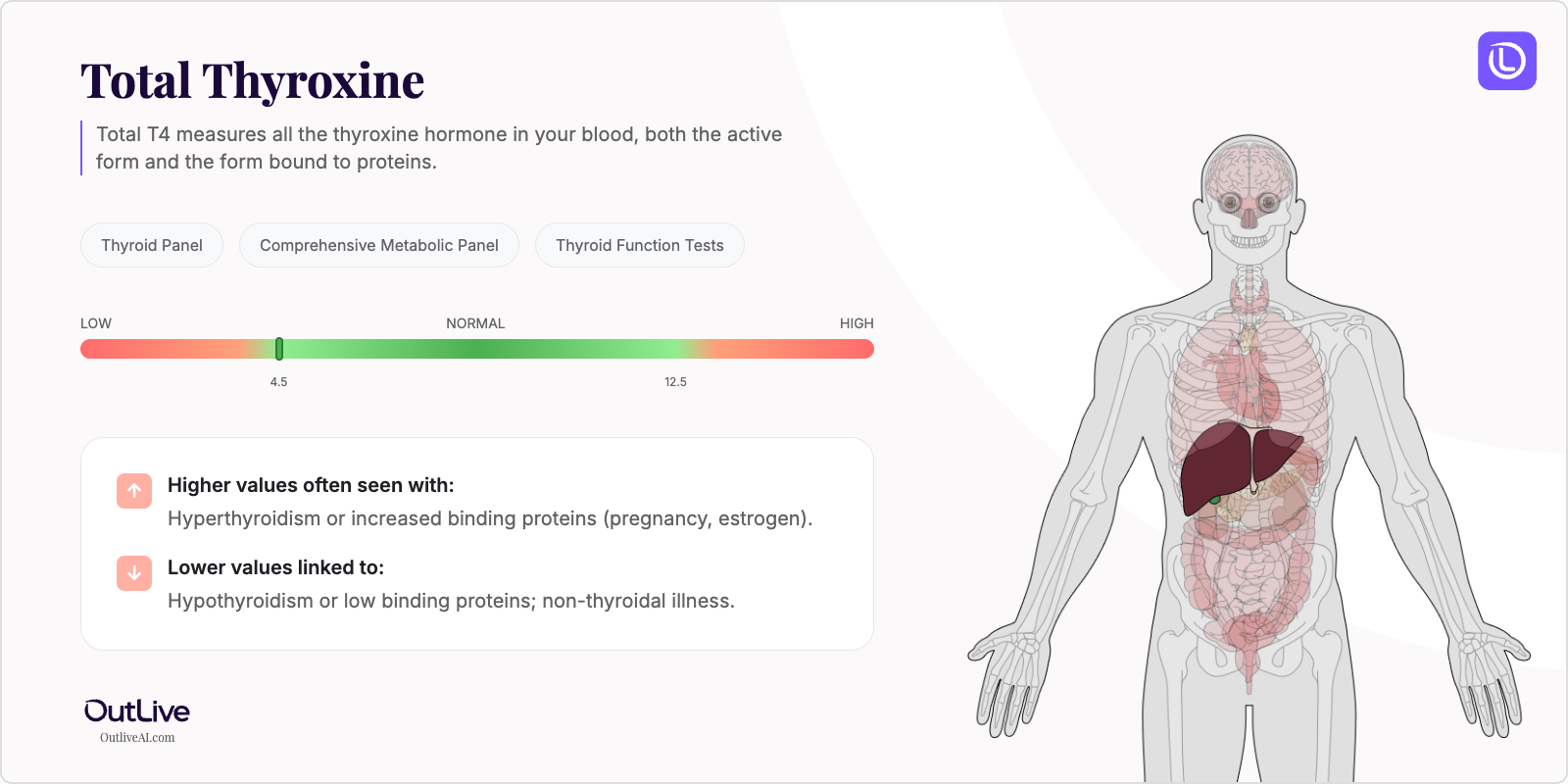
- What it is: Total T4 measures all the thyroxine hormone in your blood, both the active form and the form bound to proteins.
- Found in tests: Thyroid Panel, Comprehensive Metabolic Panel, Thyroid Function Tests
- Normal range: 4.5-12.5 μg/dL (varies slightly by lab and age)
If you're looking at your lab results and wondering what Total T4 means, you're in the right place. Think of Total T4 as a fuel gauge for your body's metabolism - it shows how much thyroid hormone is available to keep your body's engine running at the right speed. Let's break down what your numbers mean in plain English, so you can walk into your next doctor's appointment feeling informed and confident.
Why Is Total T4 Tested?
Your doctor orders a Total T4 test as part of investigating how well your thyroid gland is working. This butterfly-shaped gland in your neck acts like your body's thermostat, controlling everything from your heart rate to how quickly you burn calories. When something seems off with this crucial system, Total T4 is often one of the first tests ordered.
This test is typically included in routine thyroid panels, especially if you're experiencing symptoms like unexplained weight changes, fatigue that doesn't improve with rest, or changes in your heart rate. It's also commonly ordered during pregnancy monitoring, annual physicals for people over 35, or if you have a family history of thyroid problems.
For many patients, Total T4 serves as a screening tool that helps doctors decide whether more detailed thyroid testing is needed. It's particularly valuable for monitoring people already taking thyroid medication, helping ensure their treatment is working effectively.
What Does Total T4 Do in Your Body?
Total T4, or thyroxine, is the main hormone your thyroid gland produces - about 90% of its output. Picture it as the master key that unlocks energy production in nearly every cell of your body. Most of this hormone travels through your bloodstream attached to proteins, like passengers on a bus, while a tiny fraction travels solo as "free T4" - the immediately active form.
Your thyroid releases T4 based on signals from your brain, specifically the pituitary gland, which acts like a thermostat controller. When your body needs more energy and heat, more T4 is released. When it needs less, production slows down. This hormone affects your metabolism, body temperature, heart function, digestion, muscle control, brain development, and even bone maintenance.
The "total" in Total T4 means we're measuring both the protein-bound T4 (about 99.97%) and the free T4 (about 0.03%) together. While only the free portion is immediately active, the bound portion serves as a reserve that can be released when needed, ensuring your body has a steady supply of this crucial hormone.
What Do My Total T4 Results Mean?
Normal Total T4 Ranges
| Population | Normal Range | Optimal Range |
|---|---|---|
| Adult Male | 4.5-12.5 μg/dL | 6.0-10.0 μg/dL |
| Adult Female | 4.5-12.5 μg/dL | 6.0-10.0 μg/dL |
| Children (1-10 years) | 6.0-14.0 μg/dL | 7.0-12.0 μg/dL |
| Pregnancy (2nd/3rd trimester) | 7.5-16.0 μg/dL | 9.0-14.0 μg/dL |
| Newborns | 11.0-22.0 μg/dL | Not established |
Note: Reference ranges may vary slightly between laboratories. Always compare your results to the range provided on your specific lab report.
What Does High Total T4 Mean?
Common Causes:
- Hyperthyroidism (Graves' disease): Your thyroid is overproducing hormones, like a thermostat stuck on high
- Thyroid nodules: Small growths on your thyroid that produce extra hormone
- Thyroiditis: Inflammation causing stored hormone to leak into your bloodstream
- Too much thyroid medication: If you're being treated for hypothyroidism, your dose may be too high
- Pregnancy: Normal increases occur, especially in early pregnancy
- High protein levels: Since T4 binds to proteins, more proteins mean higher total T4
- Certain medications: Birth control pills, estrogen therapy, or drugs containing iodine
Possible Symptoms:
- Rapid or irregular heartbeat
- Unexplained weight loss despite good appetite
- Feeling hot when others are comfortable
- Trembling hands
- Anxiety or nervousness
- Difficulty sleeping
- Frequent bowel movements
When to Be Concerned: If your Total T4 is significantly elevated (above 15 μg/dL) and you're experiencing rapid heartbeat, chest pain, or severe anxiety, contact your healthcare provider promptly. Extremely high levels (above 20 μg/dL) with severe symptoms may indicate thyroid storm, a rare but serious condition requiring immediate medical attention.
What Does Low Total T4 Mean?
Common Causes:
- Hypothyroidism (underactive thyroid): Your thyroid isn't producing enough hormone
- Hashimoto's thyroiditis: An autoimmune condition where your body attacks the thyroid
- Iodine deficiency: Though rare in developed countries, lack of iodine impairs hormone production
- Pituitary problems: The gland that signals your thyroid isn't working properly
- Certain medications: Lithium, anti-seizure drugs, or some heart medications
- Recent illness or surgery: Your body may temporarily reduce thyroid hormone production
- Low protein levels: Less protein means less bound T4, lowering the total
Possible Symptoms:
- Persistent fatigue despite adequate sleep
- Unexplained weight gain
- Feeling cold when others are warm
- Dry skin and brittle hair
- Constipation
- Depression or brain fog
- Muscle weakness or aches
When to Be Concerned: If your Total T4 is below 4.0 μg/dL with symptoms like extreme fatigue, confusion, or swelling in your face and limbs, contact your doctor soon. Very low levels (below 2.0 μg/dL) with severe symptoms may indicate myxedema, a serious condition requiring medical evaluation.
What Can Affect My Total T4 Levels?
Factors That May Increase Levels:
- Medications: Birth control pills, estrogen replacement therapy, methadone, heroin, amphetamines
- Lifestyle: High-iodine diet, recent contrast dye for imaging tests
- Conditions: Pregnancy, acute hepatitis, acute psychiatric illness
- Supplements: Kelp, iodine supplements, biotin (can interfere with test accuracy)
Factors That May Decrease Levels:
- Medications: Lithium, anti-seizure drugs (phenytoin, carbamazepine), steroids, aspirin (high doses)
- Lifestyle: Severe calorie restriction, excessive soy consumption, extreme athletic training
- Conditions: Serious illness, liver disease, kidney disease, malnutrition
- Time of Day: Levels can be slightly lower in the evening
How Is Total T4 Related to Other Tests?
Total T4 is rarely interpreted alone - it's like one instrument in an orchestra that needs to harmonize with others to create the full picture.
Often tested alongside: TSH (Thyroid Stimulating Hormone), Free T4, Total T3, Free T3 Part of: Thyroid Panel, Comprehensive Metabolic Panel Ratio calculations: T3/T4 ratio can help identify conversion problems Follow-up tests: Thyroid antibodies (TPO, thyroglobulin), thyroid ultrasound, radioactive iodine uptake
Frequently Asked Questions
How often should Total T4 be tested? For healthy adults, every 5 years after age 35 is reasonable. If you have thyroid disease or take thyroid medication, your doctor may check it every 6-12 weeks initially, then every 6-12 months once stable.
Can I improve my Total T4 levels naturally? While you can't cure thyroid disease naturally, you can support thyroid health by ensuring adequate iodine intake (but not excessive), managing stress, getting quality sleep, and avoiding extreme diets. Always work with your doctor before making significant changes.
Should I fast before a Total T4 test? No fasting is required for Total T4 testing. However, take your thyroid medication after the blood draw if you're on treatment, and inform your doctor about all medications and supplements you're taking.
How quickly can Total T4 levels change? With medication adjustments, Total T4 levels begin changing within days but typically take 4-6 weeks to fully stabilize. Natural fluctuations due to illness or stress can occur within days to weeks.
Next Steps After Your Total T4 Test
Questions to Ask Your Doctor:
- What do my Total T4 results mean in combination with my other thyroid tests?
- Are my symptoms likely related to my thyroid hormone levels?
- Do I need additional testing to clarify the diagnosis?
- If my levels are abnormal, what treatment options are available?
- How often should I have my thyroid levels rechecked?
Download our Total T4 Doctor Questions Checklist
🔬 Ready to Track Your Total T4 Over Time?
Understanding a single Total T4 result is just the beginning. Our free Lab Analyzer tool helps you:
- Track how your Total T4 changes over time
- See how it relates to your other lab values
- Identify patterns your doctor might miss
- Get personalized insights based on your trends
[Upload Your Lab Report for Free Analysis →]