
📋 At a Glance
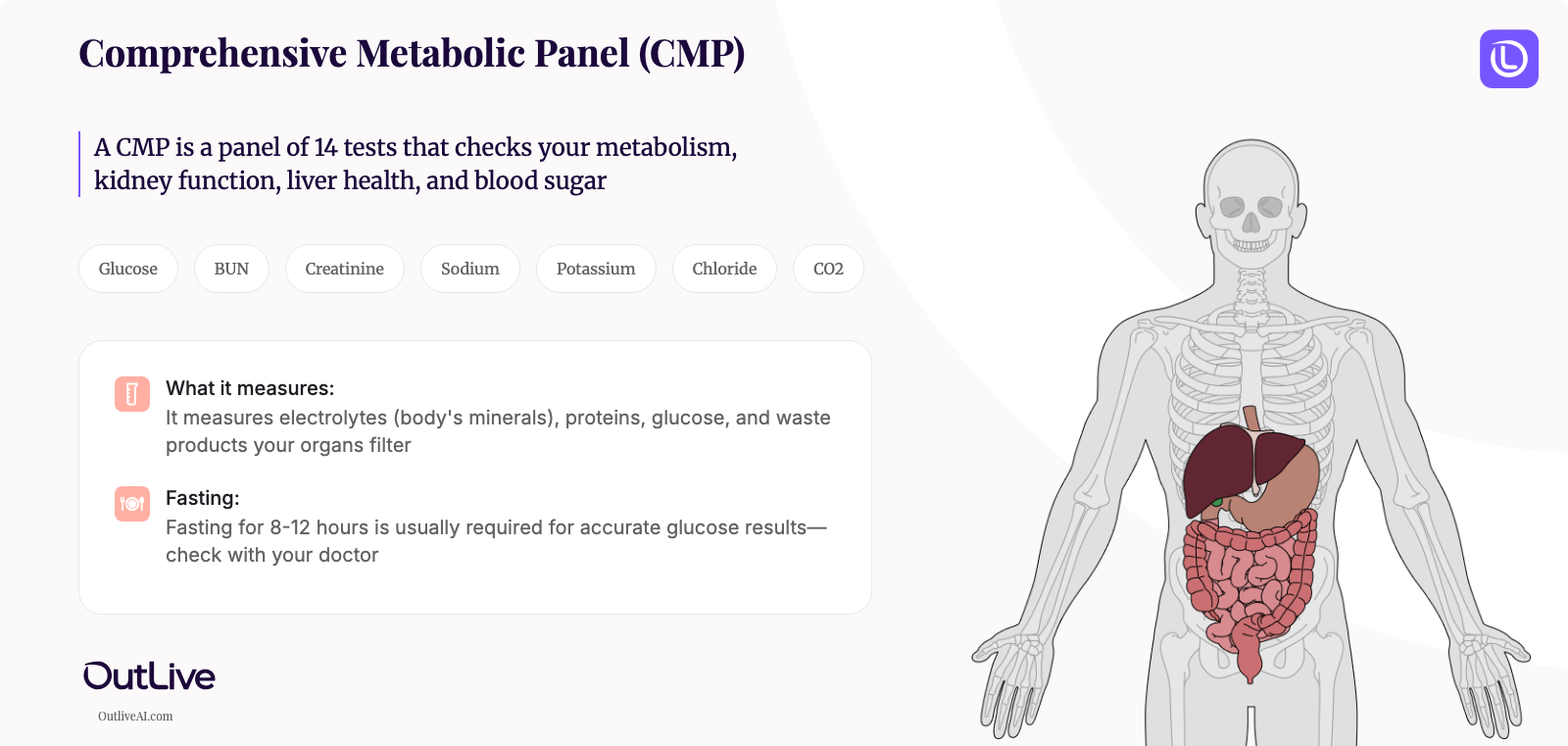
- A CMP is a panel of 14 tests that checks your metabolism, kidney function, liver health, and blood sugar
- It measures electrolytes (body's minerals), proteins, glucose, and waste products your organs filter
- Fasting for 8-12 hours is usually required for accurate glucose results—check with your doctor
If you're reading this, you've likely just had a Comprehensive Metabolic Panel—or CMP—and are looking at a report with 14 different measurements that might seem overwhelming. Take a breath. You're in the right place. This guide will walk you through what a CMP test is, what each of those numbers means, and most importantly, what you should do next. Think of us as your translator—we're here to help you understand your results so you can have a more informed conversation with your healthcare provider.
Why Is a CMP Test Ordered?
Your doctor might order a CMP test for several reasons. Think of it as a comprehensive check-up for your body's chemical balance and metabolism—like running diagnostics on your car's engine, electrical system, and fuel efficiency all at once.
The most common reasons include:
Routine health screening: A CMP is often part of your annual physical exam. It helps detect problems early, before symptoms appear.
Monitoring chronic conditions: If you have diabetes, kidney disease, liver disease, or high blood pressure, regular CMPs help track how well your treatment is working.
Investigating symptoms: If you're experiencing fatigue, nausea, confusion, excessive thirst, or unexpected weight changes, a CMP helps identify potential causes.
Medication monitoring: Certain medications can affect your kidneys, liver, or electrolyte balance. Regular CMPs ensure your medications aren't causing harmful side effects.
Pre-surgery evaluation: Before surgery, doctors need to ensure your organs are functioning well and your body chemistry is balanced for safe anesthesia and healing.
Remember, needing a CMP doesn't mean something is wrong. It's often just your doctor being thorough and proactive about your health.
How to Prepare for a CMP Test
Preparing for a CMP test usually requires some advance planning, but it's straightforward:
Fasting requirements: Most doctors will ask you to fast for 8-12 hours before your test. This means no food or drinks except water. Fasting ensures your glucose (blood sugar) reading is accurate. Black coffee or tea can affect results, so stick to water only.
Medication considerations: Continue taking your regular medications unless your doctor specifically tells you otherwise. If you take diabetes medications, ask your doctor for specific instructions about timing.
Timing tips: Many people find it easiest to schedule their test first thing in the morning. That way, you fast overnight while sleeping and can eat right after the blood draw.
The blood draw itself takes just a few minutes. A healthcare professional will clean a small area on your arm, insert a tiny needle to collect blood (usually one or two small tubes), and bandage the site. You can return to normal activities immediately, though you might want to have a snack ready for after your test if you've been fasting.
Understanding the Components of Your CMP Report
Your CMP report contains 14 different measurements, grouped into several categories based on what they tell us about your body. Let's break them down into manageable sections that make sense.
What Do the Kidney Tests in a CMP Mean?
Your kidneys are like your body's filtration system, constantly cleaning your blood and removing waste products. The CMP includes several markers that show how well they're working:
Blood Urea Nitrogen (BUN): This measures waste products from protein breakdown. Think of it as checking how much "trash" is waiting to be filtered out.
Creatinine: A waste product from muscle activity. Since it's produced at a steady rate, it's an excellent marker for kidney filtration efficiency.
BUN/Creatinine Ratio: This calculation helps doctors understand whether kidney issues are related to the kidneys themselves or other factors like dehydration.
eGFR (Estimated Glomerular Filtration Rate): This calculation estimates how well your kidneys filter waste. Think of it as your kidneys' efficiency rating—higher numbers mean better function.
Here are the typical adult ranges for kidney function markers:
| Component | Abbreviation | Typical Adult Range |
|---|---|---|
| Blood Urea Nitrogen | BUN | 7-20 mg/dL |
| Creatinine | Cr | Male: 0.7-1.3 mg/dL <br/ >Female: 0.6-1.1 mg/dL |
| BUN/Creatinine Ratio | BUN/Cr | 10:1 to 20:1 |
| Estimated GFR | eGFR | >60mL/min/1.73 m² |
What Do the Liver Tests in a CMP Mean?
Your liver is your body's chemical factory and detox center. The CMP includes several markers that indicate how well it's functioning:
Total Protein: Measures all proteins in your blood. Your liver makes most of these proteins, so levels reflect liver health and nutritional status.
Albumin: The main protein made by your liver. It helps maintain fluid balance and transports substances through your blood.
Globulin: A group of proteins involved in immune function and blood clotting. Calculated by subtracting albumin from total protein.
A/G Ratio (Albumin/Globulin Ratio): Compares these two protein types to help identify liver, kidney, or immune system issues.
Total Bilirubin: A yellow waste product from breaking down old red blood cells. Your liver processes it for removal. High levels can cause jaundice (yellowing of skin and eyes).
Alkaline Phosphatase (ALP): An enzyme found in liver, bones, and other tissues. Elevated levels might indicate liver or bone problems.
Here are the typical adult ranges for liver function markers:
| Component | Abbreviation | Typical Adult Range |
|---|---|---|
| Total Protein | TP | 6.0-8.3 g/dL |
| Albumin | Alb | 3.5-5.0 g/dL |
| Globulin | Glob | 2.3-3.5 g/dL |
| A/G Ratio | A/G | 1.1-2.5 |
| Total Bilirubin | TB | 0.2-1.2 mg/dL |
| Alkaline Phosphatase | ALP | 44-147 IU/L |
What Do My Glucose and Electrolyte Levels Mean?
Electrolytes are minerals that help regulate everything from your heartbeat to muscle contractions. Your CMP measures the most important ones, plus your blood sugar:
Glucose: Your blood sugar level. This is your body's main energy source, like gasoline for a car. The fasting requirement ensures we see your baseline level.
Sodium (Na): Helps control blood pressure and fluid balance. Think of it as your body's water manager.
Potassium (K): Critical for heart rhythm and muscle function. Your heart especially depends on just the right amount.
Chloride (Cl): Works with sodium to maintain fluid balance and proper blood pH.
Carbon Dioxide (CO2): Actually measures bicarbonate, which helps maintain your blood's pH balance. Despite the name, it's not the same as the CO2 you breathe out.
Calcium (Ca): Essential for bones, muscles, nerves, and blood clotting. The CMP measures total calcium in your blood.
Anion Gap: A calculation that helps identify acid-base imbalances or the presence of unmeasured substances in your blood.
Here are the typical adult ranges for electrolytes and glucose:
| Component | Abbreviation | Typical Adult Range |
|---|---|---|
| Glucose (Fasting) | Glu | 70-99 mg/dL |
| Sodium | Na | 136-145 mEq/L |
| Potassium | K | 3.5-5.1 mEq/L |
| Chloride | Cl | 98-107 mEq/L |
| Carbon Dioxide | CO2 | 22-29 mEq/L |
| Calcium | Ca | 8.5-10.5 mg/dL |
| Anion Gap | AG | 8-12 mEq/L |
What Do Abnormal Results Mean? (A High-Level Guide)
Seeing results outside the "normal" range can be concerning, but remember: a single abnormal value rarely tells the whole story. Many factors can affect your results, including hydration status, recent meals (if not properly fasted), medications, exercise, and even stress.
Here are some general patterns your doctor might investigate:
Kidney-related abnormalities:
- High BUN or creatinine might suggest: dehydration, kidney disease, urinary blockage, or high protein diet
- Low values might suggest: liver problems, malnutrition, or overhydration
Liver-related abnormalities:
- High bilirubin or ALP might suggest: liver disease, bile duct problems, or certain bone conditions
- Low albumin might suggest: liver disease, kidney disease, or malnutrition
Electrolyte imbalances:
- High sodium might suggest: dehydration or kidney problems
- Low sodium might suggest: overhydration, heart failure, or hormonal issues
- High potassium might suggest: kidney problems or certain medications
- Low potassium might suggest: diuretics, vomiting, or diarrhea
Glucose abnormalities:
- High glucose might suggest: diabetes, prediabetes, or stress response
- Low glucose might suggest: diabetes medication issues or certain hormonal conditions
Important disclaimer: This list is not exhaustive, and many conditions can cause similar changes. Only your healthcare provider can interpret your results in the context of your symptoms, medical history, physical exam, and other tests. Never try to diagnose yourself based on CMP results alone.
Next Steps After Your CMP Test
So you've read through your results—what now? Here's your action plan:
1. Schedule a follow-up with your doctor: Even if your results look normal to you, discuss them with your healthcare provider. They can explain what the numbers mean for your specific situation.
2. Prepare your questions: Not sure what to ask? We've created a helpful checklist of questions to bring to your appointment. [Download our CMP Doctor Questions Checklist](# to make sure you cover everything important.
3. Keep track of your results: Save a copy of your CMP report. If you have regular CMPs done, tracking trends over time can be more informative than a single test.
4. Understand the big picture: Your doctor looks at patterns, not just individual numbers. Several slightly abnormal values might be less concerning than one very abnormal value.
5. Follow your doctor's recommendations: If your doctor suggests lifestyle changes, additional tests, or treatment, make sure you understand the plan and follow through.
🔬 Ready to Translate Your Full Report?
Understanding your CMP is just the beginning. Our free Lab Analyzer tool helps you:
- Track all your lab results in one place
- Spot important trends over time
- Generate personalized questions for your doctor
- Get plain-English explanations of every test
[Upload Your Lab Report for Free Analysis →]
Join 50,000+ people taking control of their health journey
Remember, knowledge is power when it comes to your health. Understanding your CMP results is an important step in taking an active role in your healthcare journey. You've already taken the first step by educating yourself—now use that knowledge to have better, more productive conversations with your healthcare provider.