
📋 At a Glance
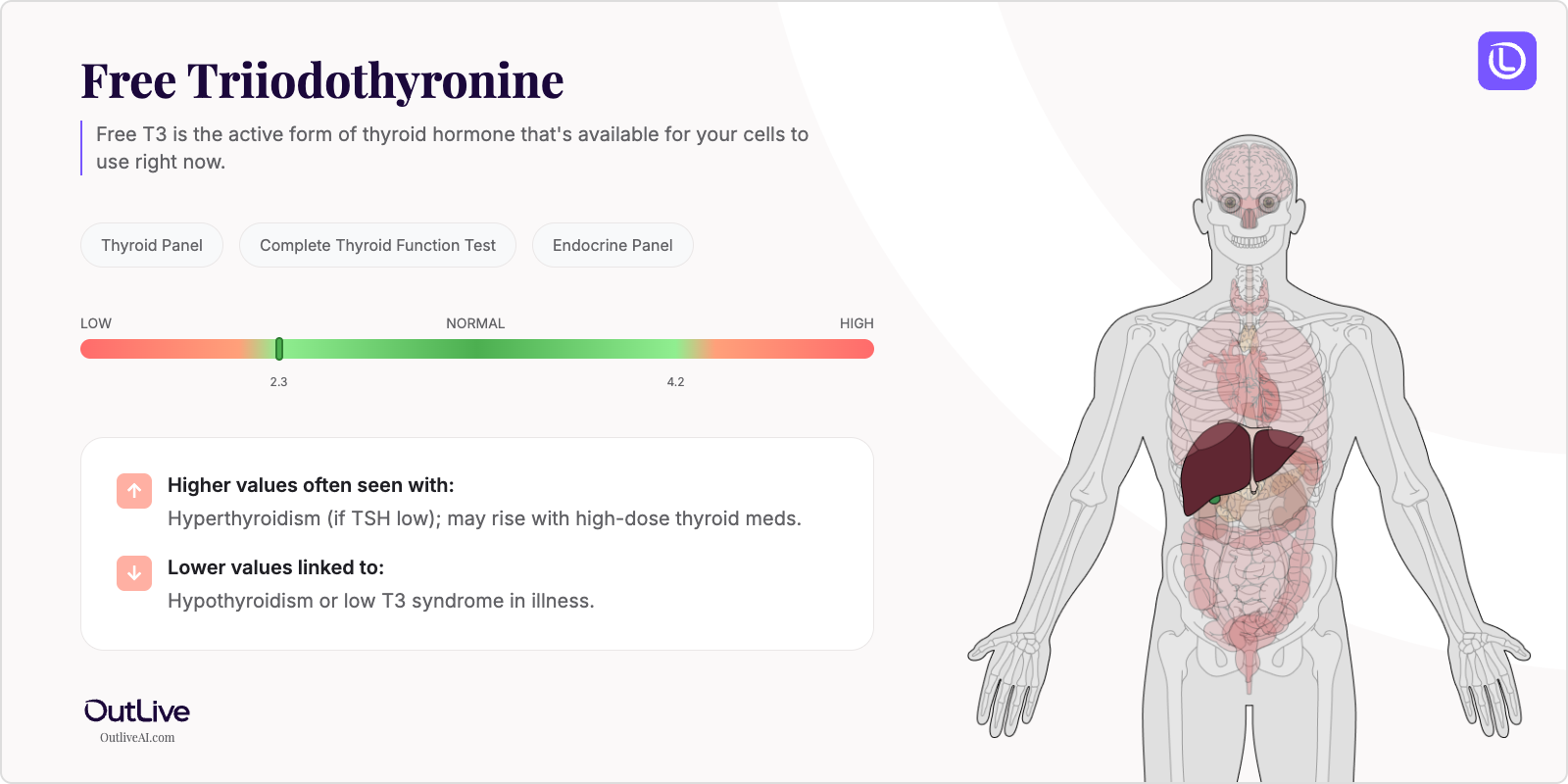
- What it is: Free T3 is the active form of thyroid hormone that's available for your cells to use right now.
- Found in tests: Thyroid Panel, Complete Thyroid Function Test, Endocrine Panel
- Normal range: 2.3-4.2 pg/mL (may vary by lab and age)
If you're looking at your lab results and wondering what Free T3 means, you're in the right place. Think of Free T3 as the "ready-to-work" thyroid hormone in your bloodstream – like having cash in your wallet versus money locked in a savings account. While most thyroid hormone is bound to proteins (like money in the bank), Free T3 is the small but mighty portion that's immediately available to help regulate your metabolism, energy, and body temperature. Let's break down what your numbers mean in plain English.
Why Is Free T3 Tested?
Your doctor ordered a Free T3 test to get a complete picture of how your thyroid is functioning. While the more common TSH and T4 tests tell part of the story, Free T3 shows whether your body is successfully converting thyroid hormone into its most active, usable form. It's like checking not just if you have fuel in your car's tank, but whether that fuel is actually reaching your engine.
This test is particularly valuable when your doctor suspects hyperthyroidism (overactive thyroid), or when your TSH and T4 results don't quite match your symptoms. Some people have normal T4 levels but struggle to convert it to T3, leaving them with hypothyroid symptoms despite "normal" standard tests. Free T3 helps solve this puzzle.
Free T3 testing is also crucial for monitoring thyroid medication effectiveness, especially if you're taking T3-containing medications like Cytomel or natural desiccated thyroid. It helps ensure you're getting the right dose – not too much, not too little, but just right for your body's needs.
What Does Free T3 Do in Your Body?
Free T3 is like your body's metabolic thermostat and energy manager rolled into one. Every cell in your body has receptors for T3, which means this hormone influences virtually every system – from how fast your heart beats to how quickly you burn calories, from your body temperature to your mood and mental clarity.
Your thyroid gland produces mostly T4 (about 80%), which is then converted to T3 in your liver, kidneys, and other tissues. Think of T4 as the raw material and T3 as the finished product. While T4 is important for storage and transport, T3 is about 3-4 times more potent and is what actually gets the job done at the cellular level.
The "free" in Free T3 refers to the tiny portion (about 0.3%) of total T3 that isn't bound to proteins in your blood. This unbound portion is what matters most because it can enter your cells and activate processes that keep you feeling energetic, warm, and mentally sharp. When Free T3 levels are off, you feel it throughout your entire body.
What Do My Free T3 Results Mean?
Normal Free T3 Ranges
| Population | Normal Range | Optimal Range |
|---|---|---|
| Adult Male | 2.3-4.2 pg/mL | 3.0-3.5 pg/mL |
| Adult Female | 2.3-4.2 pg/mL | 3.0-3.5 pg/mL |
| Children (1-5 years) | 2.0-5.7 pg/mL | Mid-range |
| Children (6-10 years) | 2.7-5.2 pg/mL | Mid-range |
| Pregnancy (1st trimester) | 2.3-4.8 pg/mL | Varies by trimester |
| Pregnancy (2nd-3rd trimester) | 2.3-3.8 pg/mL | Varies by trimester |
| Adults over 60 | 2.0-3.8 pg/mL | 2.5-3.2 pg/mL |
Note: Reference ranges may vary slightly between laboratories. Always compare your results to the range provided on your specific lab report.
What Does High Free T3 Mean?
Common Causes:
- Graves' disease: An autoimmune condition where antibodies overstimulate your thyroid
- Toxic multinodular goiter: Multiple overactive nodules in the thyroid producing excess hormone
- Thyroiditis: Inflammation releasing stored hormone into the bloodstream
- Excessive thyroid medication: Taking too much levothyroxine, Cytomel, or natural thyroid
- TSH-producing pituitary tumor: Rare but causes the pituitary to overstimulate the thyroid
- High iodine intake: From supplements, medications, or contrast dyes
- T3 thyrotoxicosis: A specific type of hyperthyroidism with elevated T3 but normal T4
Possible Symptoms:
- Rapid or irregular heartbeat (feeling like your heart is racing)
- Unexplained weight loss despite normal or increased appetite
- Anxiety, irritability, or feeling "wired but tired"
- Trembling hands or inner tremor sensation
- Excessive sweating and heat intolerance
- Frequent bowel movements or diarrhea
- Difficulty sleeping or insomnia
When to Be Concerned: If your Free T3 is significantly elevated (above 6.0 pg/mL) and you're experiencing rapid heartbeat, chest pain, severe anxiety, or confusion, contact your healthcare provider immediately. These could be signs of thyroid storm, a rare but serious condition requiring prompt treatment.
What Does Low Free T3 Mean?
Common Causes:
- Hashimoto's thyroiditis: Autoimmune destruction of thyroid tissue reducing hormone production
- Iodine deficiency: Lack of this essential mineral needed to make thyroid hormone
- Pituitary dysfunction: The master gland isn't signaling the thyroid properly
- Chronic illness or stress: Your body downregulates T3 production to conserve energy
- Certain medications: Beta-blockers, steroids, or amiodarone can lower T3
- Poor T4 to T3 conversion: Often due to nutritional deficiencies or liver problems
- Extreme dieting or eating disorders: Severe calorie restriction suppresses thyroid function
Possible Symptoms:
- Persistent fatigue despite adequate sleep
- Weight gain or difficulty losing weight
- Feeling cold when others are comfortable
- Dry skin, brittle nails, and hair loss
- Constipation
- Depression, brain fog, or difficulty concentrating
- Muscle weakness or joint pain
When to Be Concerned: Very low Free T3 levels (below 1.5 pg/mL) combined with severe fatigue, confusion, or extremely low body temperature warrant immediate medical attention, as these could indicate myxedema, a severe form of hypothyroidism.
What Can Affect My Free T3 Levels?
Factors That May Increase Levels:
- Medications: Birth control pills, estrogen therapy, methadone, clofibrate
- Lifestyle: High-protein diet, regular exercise (acutely after workout)
- Conditions: Pregnancy (first trimester), acute psychiatric illness
- Supplements: High-dose iodine, tyrosine supplements
Factors That May Decrease Levels:
- Medications: Propranolol, steroids, amiodarone, lithium, phenytoin
- Lifestyle: Severe calorie restriction, excessive alcohol use, smoking
- Conditions: Chronic stress, serious illness, liver or kidney disease
- Time of Day: Levels can be slightly lower in the evening
- Nutritional deficiencies: Low selenium, zinc, iron, or vitamin D
How Is Free T3 Related to Other Tests?
Free T3 is rarely tested alone – it's part of a thyroid detective story that includes multiple clues. It's most commonly ordered alongside TSH (thyroid-stimulating hormone) and Free T4 to get a complete thyroid picture. The relationship between these three tests helps your doctor understand where any thyroid problem originates.
Often tested alongside: TSH, Free T4, Total T3, Thyroid Antibodies (TPO, TgAb) Part of: Comprehensive Thyroid Panel, Complete Metabolic Panel Plus Ratio calculations: Free T3/Free T4 ratio helps assess conversion efficiency Follow-up tests: Reverse T3, thyroid antibodies, thyroid ultrasound if abnormal
Frequently Asked Questions
How often should Free T3 be tested? If you're being treated for thyroid disease, every 6-12 weeks initially, then every 6-12 months once stable. For monitoring general health, annual testing is usually sufficient unless symptoms develop.
Can I improve my Free T3 levels naturally? Yes, supporting healthy conversion includes: ensuring adequate selenium, zinc, and iron intake; managing stress; getting quality sleep; avoiding extreme dieting; and treating any underlying inflammation or gut issues.
Should I fast before a Free T3 test? Fasting isn't required for Free T3 testing, but consistency is key. If you take thyroid medication, ask your doctor whether to take it before the blood draw.
How quickly can Free T3 levels change? Free T3 has a short half-life (about 1 day), so levels can change within days to weeks with medication adjustments or lifestyle changes, unlike T4 which takes 6-8 weeks to stabilize.
Next Steps After Your Free T3 Test
Questions to Ask Your Doctor:
- What do my Free T3 results mean in context with my other thyroid tests?
- Is my body converting T4 to T3 efficiently?
- Could my symptoms be related to my Free T3 level even if it's "normal"?
- Should we test for thyroid antibodies or other related markers?
- Would adjusting my medication or adding T3 help my symptoms?
- Are there lifestyle changes that could optimize my Free T3?
Download our Free T3 Doctor Questions Checklist
🔬 Ready to Track Your Free T3 Over Time?
Understanding a single Free T3 result is just the beginning. Our free Lab Analyzer tool helps you:
- Track how your Free T3 changes over time
- See how it relates to your other lab values
- Identify patterns your doctor might miss
- Get personalized insights based on your trends
[Upload Your Lab Report for Free Analysis →]