
📋 At a Glance
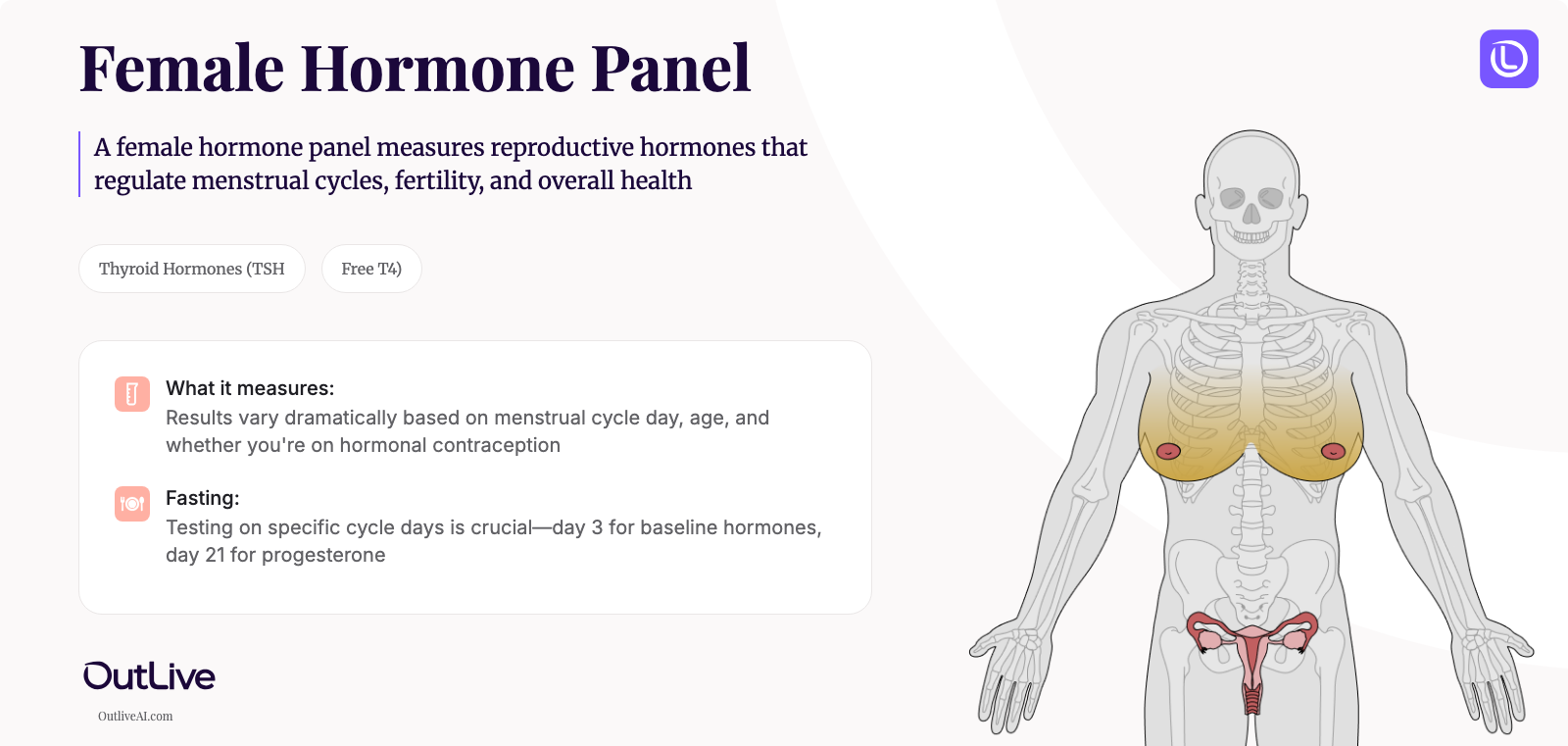
- A female hormone panel measures reproductive hormones that regulate menstrual cycles, fertility, and overall health
- Results vary dramatically based on menstrual cycle day, age, and whether you're on hormonal contraception
- Testing on specific cycle days is crucial—day 3 for baseline hormones, day 21 for progesterone
If you're reading this, you've likely just had a Female Hormone Panel and are looking at results with terms like "FSH," "estradiol," and "progesterone" along with ranges that might seem confusing or concerning. Take a breath. You're in the right place. This guide will walk you through what a female hormone panel is, what each hormone means for your health, and most importantly, what you should do next. Think of us as your translator—we're here to help you understand your results so you can have a more informed conversation with your healthcare provider.
Why Is a Female Hormone Panel Ordered?
Your doctor might order a female hormone panel for several reasons. Think of your hormones as an orchestra—when they're in harmony, everything works beautifully. But when one instrument is out of tune, the whole performance suffers. Hormone imbalances can affect everything from your periods to your mood to your ability to conceive.
The most common reasons include:
Irregular periods: If your periods are absent, irregular, heavy, or painful, hormone testing helps identify causes like PCOS, thyroid issues, or approaching menopause.
Fertility evaluation: For couples trying to conceive, hormone panels assess ovarian reserve, confirm ovulation, and identify hormonal causes of infertility.
Menopause assessment: To confirm menopause, evaluate perimenopause symptoms, or monitor hormone replacement therapy effectiveness.
PCOS investigation: Polycystic ovary syndrome affects 1 in 10 women. Hormone panels help diagnose PCOS by checking testosterone, LH/FSH ratio, and other markers.
Unexplained symptoms: Symptoms like hot flashes, night sweats, mood swings, low libido, weight gain, acne, or excessive hair growth often prompt hormone testing.
Abnormal bleeding: Bleeding between periods, after menopause, or extremely heavy periods require hormone evaluation to identify causes.
Early or delayed puberty: In younger patients, hormone panels evaluate whether development is progressing normally.
Monitoring hormone therapy: Whether for contraception, fertility treatment, or menopause, regular testing ensures appropriate hormone levels.
Remember, hormone levels naturally fluctuate throughout your cycle, with age, and even throughout the day—interpretation requires considering all these factors.
How to Prepare for a Female Hormone Panel Test
Proper preparation and timing are crucial for accurate results:
Critical: Cycle day timing
- Day 3 testing (days 2-4 acceptable): For FSH, LH, estradiol baseline
- Day 21 testing (or 7 days post-ovulation): For progesterone to confirm ovulation
- Random timing: If periods are absent or very irregular
- Day 1 = first day of full menstrual flow (not spotting)
Inform your doctor about:
- Last menstrual period date
- Cycle length and regularity
- Hormonal contraception (pills, IUD, patches, rings)
- Fertility medications
- Hormone replacement therapy
- Supplements (especially DHEA, biotin)
- Recent pregnancy or breastfeeding
Medication considerations:
- Continue prescribed medications unless told otherwise
- Birth control affects all results—may need to stop for accurate testing
- Biotin supplements interfere with many hormone tests—stop 72 hours before
Fasting requirements:
- Usually not required for hormones
- May be needed if lipids or glucose included
- Follow specific instructions
Best practices:
- Test in the morning (some hormones peak then)
- Avoid intense exercise 24 hours before
- Note any unusual stress or illness
- For multiple hormone tests, try to maintain consistent timing
The blood draw typically requires 2-3 tubes. Results usually return within 2-5 days.
Understanding the Components of Your Female Hormone Panel Report
Your hormone panel tells the complex story of your reproductive system. Each hormone plays a specific role, and their relationships to each other matter as much as individual levels.
What Do the Main Reproductive Hormones Mean?
These hormones work together to control your menstrual cycle and fertility:
Estradiol (E2): The main form of estrogen during reproductive years. Think of it as the master regulator of female characteristics—it controls menstrual cycles, maintains vaginal health, affects mood, and protects bones. Levels vary dramatically through your cycle, peaking just before ovulation.
Progesterone: The "pregnancy hormone" that prepares and maintains the uterine lining. After ovulation, progesterone should rise significantly. Low day-21 progesterone suggests you're not ovulating. It also affects mood, sleep, and temperature.
FSH (Follicle Stimulating Hormone): Made by your pituitary gland to stimulate egg development. Think of FSH as the "push" your ovaries need to work. High FSH means your brain is working harder to get your ovaries to respond—often indicating declining ovarian reserve or menopause.
LH (Luteinizing Hormone): Triggers ovulation mid-cycle. The LH surge causes the egg to release. The LH/FSH ratio is important—elevated in PCOS. LH works with FSH like a team to control your cycle.
AMH (Anti-Müllerian Hormone): Indicates your ovarian reserve—how many eggs you have left. Unlike other hormones, AMH doesn't fluctuate with your cycle, making it useful for fertility planning. Think of it as your egg savings account balance.
Testosterone (Total and Free): Yes, women need testosterone too! Important for libido, energy, and muscle mass. But excess causes acne, male-pattern hair growth, and irregular periods. Free testosterone is the active form.
Here are typical ranges for main reproductive hormones:
| Hormone | Follicular Phase (Days 1-14) | Ovulation | Luteal Phase (Days 15-28) | Postmenopausal |
|---|---|---|---|---|
| Estradiol | 30-100 pg/mL | 100-400 pg/mL | 60-150 pg/mL | \ <30pg/mL |
| Progesterone | \ <1ng/mL | 1-3 ng/mL | 5-20 ng/mL | \ <1ng/mL |
| FSH | 3-10 mIU/mL | 4-25 mIU/mL | 2-8 mIU/mL | \ >30mIU/mL |
| LH | 2-8 mIU/mL | 10-40 mIU/mL | 2-8 mIU/mL | \ >30mIU/mL |
| AMH | 1.0-4.0 ng/mL (age-dependent) | Same | Same | \ <1.0ng/mL |
| Testosterone | 15-70 ng/dL | Same | Same | 5-25 ng/dL |
What Do Additional Hormone Tests Mean?
Other hormones that affect reproductive health:
Prolactin: Made by the pituitary, prolactin stimulates milk production but when elevated without pregnancy, it suppresses ovulation. High prolactin can cause irregular periods, milky discharge, and infertility.
DHEA-S: An androgen (male hormone) made by adrenal glands. Elevated in PCOS and adrenal disorders. More stable than testosterone for diagnosing excess androgens.
SHBG (Sex Hormone Binding Globulin): Binds to sex hormones, affecting how much is active. Low SHBG means more free testosterone (common in PCOS). High SHBG means less available hormone.
17-Hydroxyprogesterone: Screens for congenital adrenal hyperplasia, a genetic cause of excess androgens.
Thyroid Hormones (TSH, Free T4): Thyroid problems commonly cause menstrual irregularities. Always checked with reproductive hormones.
Cortisol: The stress hormone. Chronic elevation suppresses reproductive hormones. Can indicate Cushing's syndrome if very high.
What Do Abnormal Results Mean? (A High-Level Guide)
Hormone interpretation requires considering patterns, not just individual values:
PCOS (Polycystic Ovary Syndrome) Pattern:
- High LH/FSH ratio (often >2:1)
- Elevated testosterone or free testosterone
- High DHEA-S
- Low SHBG
- Often insulin resistance
- May have normal or high AMH
- Symptoms: Irregular periods, acne, hirsutism, weight gain
Perimenopause/Menopause Pattern:
- FSH >30 mIU/mL (especially if consistent)
- Low estradiol (<30 pg/mL)
- LH elevated
- AMH very low or undetectable
- Irregular periods before stopping
- Symptoms: Hot flashes, night sweats, mood changes
Diminished Ovarian Reserve Pattern:
- High day-3 FSH (>10 mIU/mL)
- Low AMH (<1.0 ng/mL)
- Low day-3 estradiol
- Poor response to fertility medications
- May still have regular periods
- Important for fertility planning
Hypothalamic Amenorrhea Pattern:
- Low FSH and LH
- Low estradiol
- No periods
- Common causes: Low body weight, excessive exercise, stress
- Reversible with lifestyle changes
Hyperprolactinemia Pattern:
- Elevated prolactin (>25 ng/mL)
- Suppressed LH and FSH
- Low progesterone (no ovulation)
- May have milky nipple discharge
- Need MRI to rule out pituitary tumor
Anovulation Pattern:
- Day-21 progesterone <3 ng/mL
- May have normal other hormones
- Regular or irregular periods but no ovulation
- Common cause of infertility
Premature Ovarian Insufficiency (POI):
- FSH >40 mIU/mL before age 40
- Low estradiol
- Absent periods
- Different from normal menopause timing
- May be genetic or autoimmune
Important Age Considerations:
- 20s-30s: Most stable hormone patterns
- Late 30s-40s: Declining AMH, occasional high FSH
- Perimenopause (45-55): Wildly fluctuating hormones
- Post-menopause: Consistently low estrogen/progesterone, high FSH/LH
Birth Control Effects:
- Suppresses FSH and LH
- Synthetic hormones not measured by tests
- Need to stop for 3 months for accurate natural hormone levels
- Mirena IUD may allow ovulation but affects periods
Important disclaimer: Hormone interpretation is complex and highly individual. A single abnormal result rarely tells the whole story. Hormone levels must be interpreted with symptoms, cycle day, age, and health history. Only your healthcare provider can diagnose hormonal conditions. Never start or stop hormone treatments based on lab results alone.
Next Steps After Your Female Hormone Panel Test
So you've read through your results—what now? Here's your action plan:
1. Schedule a follow-up with your doctor: Hormone results always need professional interpretation considering your symptoms, age, and goals.
2. Prepare your questions: Not sure what to ask? We've created a helpful checklist of questions to bring to your appointment. [Download our Female Hormone Panel Doctor Questions Checklist](# to make sure you cover everything important.
3. Based on your results and situation:
If trying to conceive:
- Confirm ovulation with day-21 progesterone
- Check ovarian reserve (AMH, day-3 FSH)
- Partner needs semen analysis
- Consider fertility specialist if abnormal
If PCOS suspected:
- Metabolic testing (glucose, insulin)
- Ultrasound for ovarian cysts
- Discuss treatment options (lifestyle, metformin, birth control)
- Address symptoms (acne, hair growth)
If approaching menopause:
- Discuss symptom management
- Consider hormone replacement therapy risks/benefits
- Bone density testing
- Cardiovascular risk assessment
4. Track your cycles:
- Use apps or calendars
- Note symptoms and timing
- Track basal body temperature if trying to conceive
- Document bleeding patterns
5. Lifestyle optimization:
- Maintain healthy weight: Both low and high extremes affect hormones
- Manage stress: Chronic stress suppresses reproductive hormones
- Exercise moderately: Too much or too little affects cycles
- Nutrition: Adequate calories, healthy fats for hormone production
- Sleep: 7-9 hours for hormone regulation
6. Know when to seek specialist care:
- Infertility after 12 months trying (6 months if over 35)
- Absent periods for 3+ months
- Severe PCOS symptoms
- Premature menopause signs
- Recurrent miscarriages
🔬 Ready to Translate Your Full Report?
Understanding your female hormone panel is just the beginning. Our free Lab Analyzer tool helps you:
- Track all your lab results in one place
- Spot important trends over time
- Generate personalized questions for your doctor
- Get plain-English explanations of every test
[Upload Your Lab Report for Free Analysis →]
Join 50,000+ people taking control of their health journey
Remember, knowledge is power when it comes to your health. Understanding your hormone levels helps you work with your healthcare provider to address imbalances, optimize fertility, manage symptoms, and maintain long-term health. Hormones are complex and constantly changing, but with proper testing and interpretation, you can take control of your reproductive health. You've already taken the first step by educating yourself—now use that knowledge to advocate for the care you need.